When a strong player says "he just does not have enough value here," that is not a read or a feeling. It is arithmetic. They have counted the combinations of hands the villain can hold, weighed the value against the bluffs, and compared it to the price. Combinatorics is the least visible fundamental in poker and one of the most powerful, because it turns "he might have it" into an actual number. Here is how to count, and why the pros never stop doing it.
What a combo is
Every specific hand can exist in a fixed number of ways, because there are four suits and the cards are physical. Learn three numbers and you can count almost anything:
So any given ace-king, suited or offsuit, is 16 combinations: 4 suited plus 12 offsuit. That single fact is worth memorising, because ace-king is the reference hand you will reason from constantly.
Blockers, the reason your own cards matter
Now the part that makes counting powerful. The cards in your hand remove combinations from the villain's range, because a card cannot be in two places at once. This is called a blocker, and it is the mechanism behind a huge amount of expert play.
Hold one ace and the number of ace-king combinations your opponent can have drops from 16 to 12, because you are holding one of the aces.
Hold the ace of hearts A♥ on a heart flush board, and every nut-flush combination that needs that exact card is gone. You have not changed the board, but you have changed what your opponent can credibly hold, and that changes whether you call or fold.
Counting value against bluffs
Put the two ideas together and you get the skill that wins pots: on the river, count the combinations of hands that beat you against the combinations that are bluffing, then compare the ratio to your price. This is the same comparison you make with pot odds, except the equity comes from a combination count rather than a draw.
Suppose you have decided the villain either has a made straight or a missed flush draw firing as a bluff. Count them.
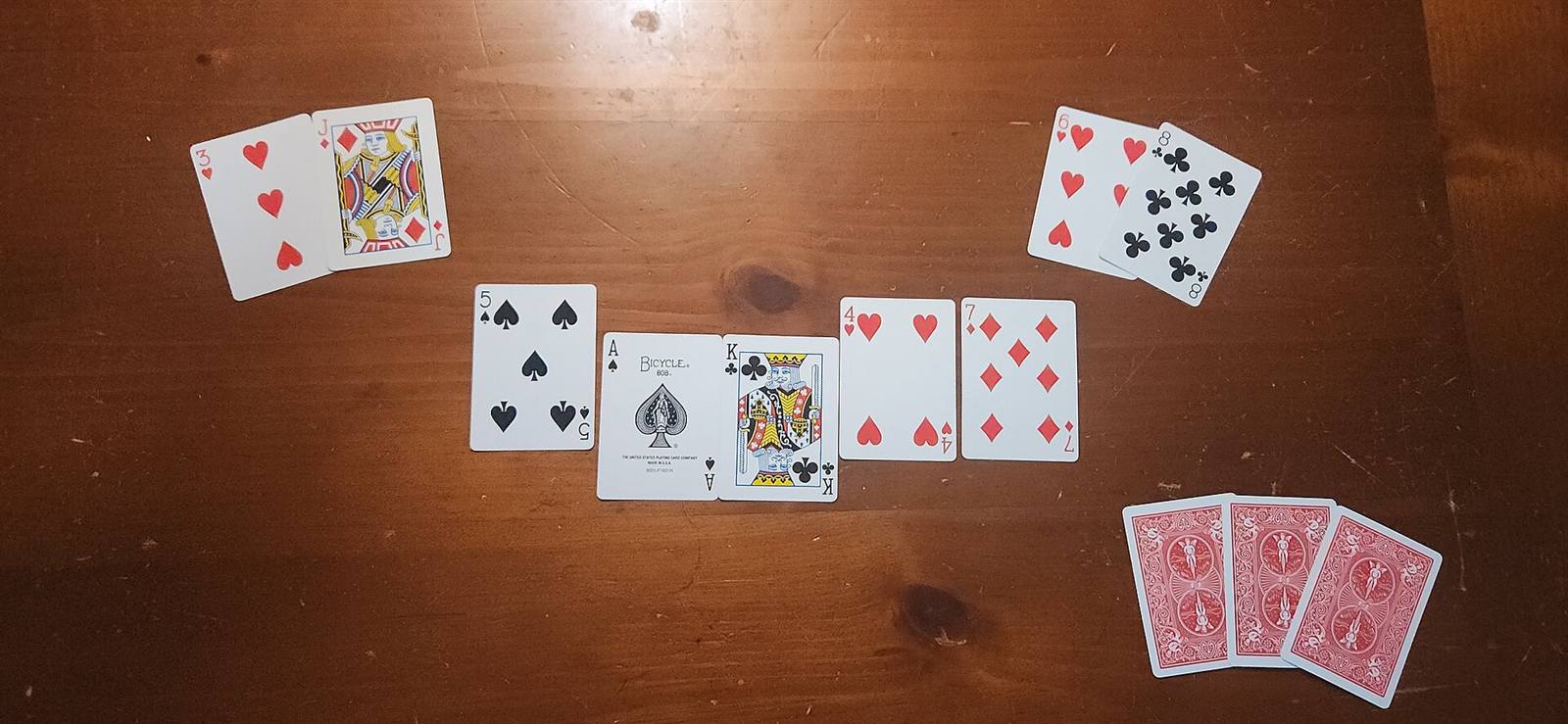 Every hand at showdown was a fixed number of combinations all along. Counting them before the river is the skill.
This is why blockers guide your bluffs too. When you choose a bluff, the best candidate is usually the hand that blocks the most value the villain can call with. Holding a card that makes their strongest hands less likely means your bluff gets through more often. It is the same counting, run from the other side of the table.
The clearest pro example: the ace-blocker four-bet
The most documented piece of combinatorial thinking in the modern game is the suited-ace four-bet bluff. Before the flop, strong players like to four-bet bluff with hands like ace-five suited and ace-four suited, and the reason is pure blockers. Holding an ace removes combinations of aces, ace-king and ace-queen from the opponent's range, the exact hands that would want to continue against a four-bet. The suited wheel ace also keeps a straight and flush backup for the times the bluff gets called. It is a hand chosen almost entirely by the maths, and it shows up at every level of high-stakes poker.
Why you have to drill it, not just learn it
You have now learned combinatorics. That is not the same as being able to use it. At the table you have seconds to count value against bluffs while the pot grows and the dealer waits, and conscious counting is far too slow to run in real time. The skill has to become automatic, which means reps.
The Combo Counter drill exists for exactly this. It runs you through counts across pairs, suited and offsuit hands, then adds blocker scenarios where your own cards change the total, until the numbers arrive without effort. Pair it with the Equity Simulator when you want to see how those counts translate into raw equity in a specific spot. And because this is a skill that compounds, it belongs in the daily routine described in Poker Drills: How to Get Better in 20 Minutes a Day.
The habit that separates regulars from recreational players
Recreational players decide with a feeling about what the villain "probably" has. Regulars decide with a count. Neither is guaranteed to be right on a single hand, but over thousands of hands the count wins, because it is anchored to something real: the fixed number of ways a hand can exist, minus the ways your own cards rule out. Learn the three numbers, understand blockers, then drill the counting until it is reflex. That is the quiet edge the best players never stop using.
Learn the three numbers, understand blockers, then drill the counting until it is instant. That is the edge the best players never put down. Start training free at drills.poker.