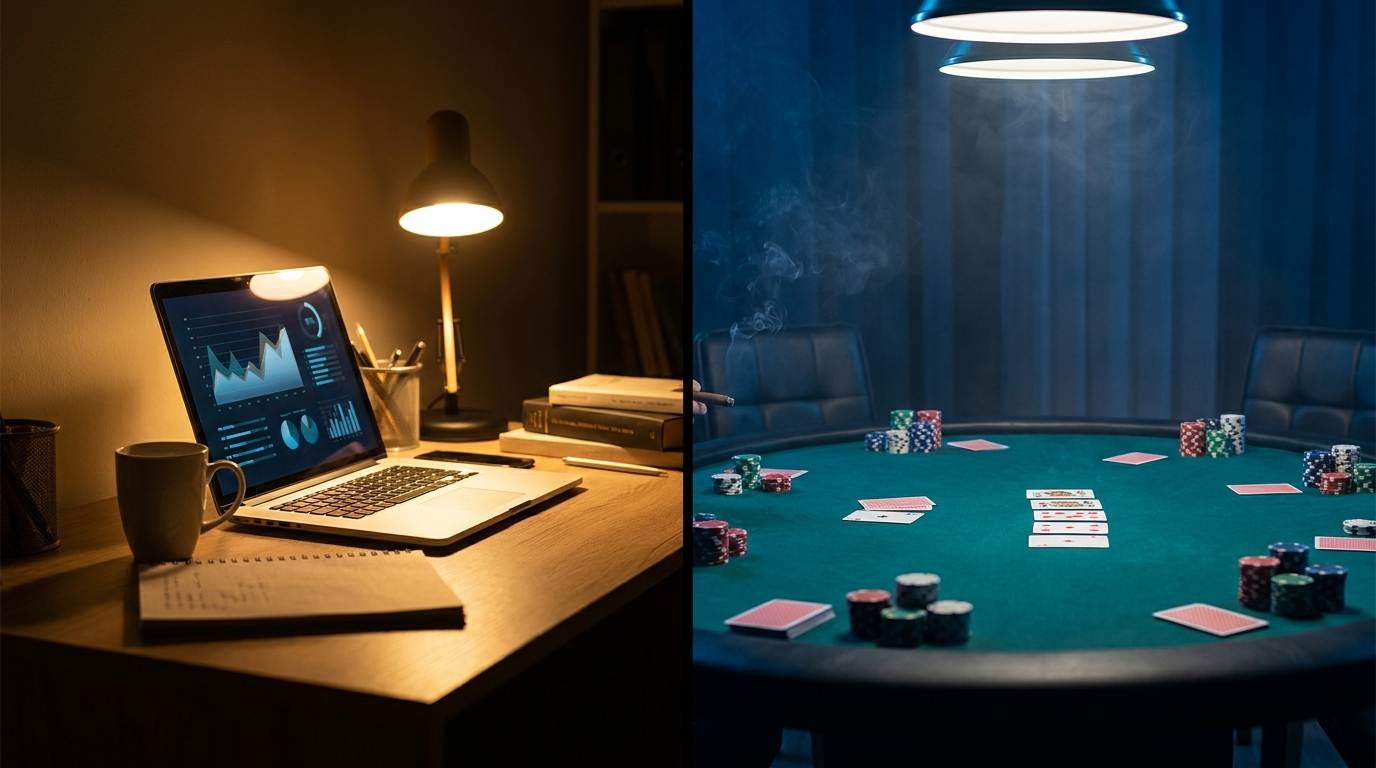
Solvers are the most powerful study tool poker has ever produced. They will tell you the game theory optimal play in any spot you can define, to a precision no human coach can match. And yet most players who grind them improve slowly, if at all, and cannot reproduce at the table what they saw on the screen the night before. This is not a knock on solvers. It is a fact about how human skill forms, and understanding it will make you better use of every study tool you own.
The solver gives you an answer, not a skill
When you run a spot in a solver, you get the answer: bet this size at this frequency with this part of your range. It is correct, it is precise, and it is delivered while you sit at your desk with unlimited time and full attention. All of which is exactly the problem.
The table gives you none of those conditions. You have seconds, not minutes. You have stress, not calm. And you have one specific runout, not the clean abstraction on the screen. The solver moved you to conscious competence, the stage where you can produce the right answer with effort and attention. It did nothing to move you to unconscious competence, the stage where the answer arrives automatically under pressure, which is the only stage the table rewards. That gap between the two stages is explained in The Unconscious Competence Ladder.
Memory does not work the way study feels
There is a deeper reason solver study fades: the way it feels productive is almost the opposite of the way it builds durable memory.
A long solver session feels like hard work and real progress. But cramming a lot of material in one sitting produces memory that decays fast. Durable, automatic recall is built by the opposite pattern: small amounts, repeated across many days, with the difficulty of actually retrieving the answer each time. Passively watching a solver confirm the right play is comfortable and forgettable. Being forced to produce the answer yourself, quickly, again and again, is uncomfortable and it sticks. This is well established outside poker, and it is why a reading list never made anyone a player.
What actually transfers
If the goal is skill you can use under pressure, the study has to look like the thing you are training for. That means short, frequent, effortful reps with immediate feedback, on the specific decisions poker actually asks of you: pricing calls, converting outs, counting combinations, reading ranges.
This is not an argument against solvers. It is an argument about sequence. Use the solver to find the right answer and understand why it is right. Then drill that decision, under a timer, until you can produce it without the solver, without the calculation, without the time. The solver is where you learn what correct looks like. Drilling is where correct becomes automatic. The two together are far more powerful than either alone.
The practical version
Keep your solver work, but change what you do with it. When a spot surprises you, do not just note the answer and move on. Identify the underlying skill, whether it is a frequency, a range read, or a pot-odds threshold, and then drill that skill until it is reflexive. The Pot Odds Trainer, the Combo Counter and the GTO Principles drill exist for exactly this handoff, taking the concepts a solver teaches and grinding them into instinct. Then confirm it is working by tracking your results in the bankroll tracker, and build the whole thing into the daily habit in How to Get Better at Poker.
Solvers tell you the truth. Drilling is how the truth survives the walk to the casino.
Use the solver to find the truth, then drill until the truth is automatic. Start training free at drills.poker.